The web is no longer just for humans and search crawlers. AI agents—systems that perceive, reason, act, and iterate toward goals—are increasingly navigating sites, extracting information, calling APIs, authenticating, and even completing transactions. Most of the internet was not built for them. According to estimates from related research, a large majority of sites still present significant friction.
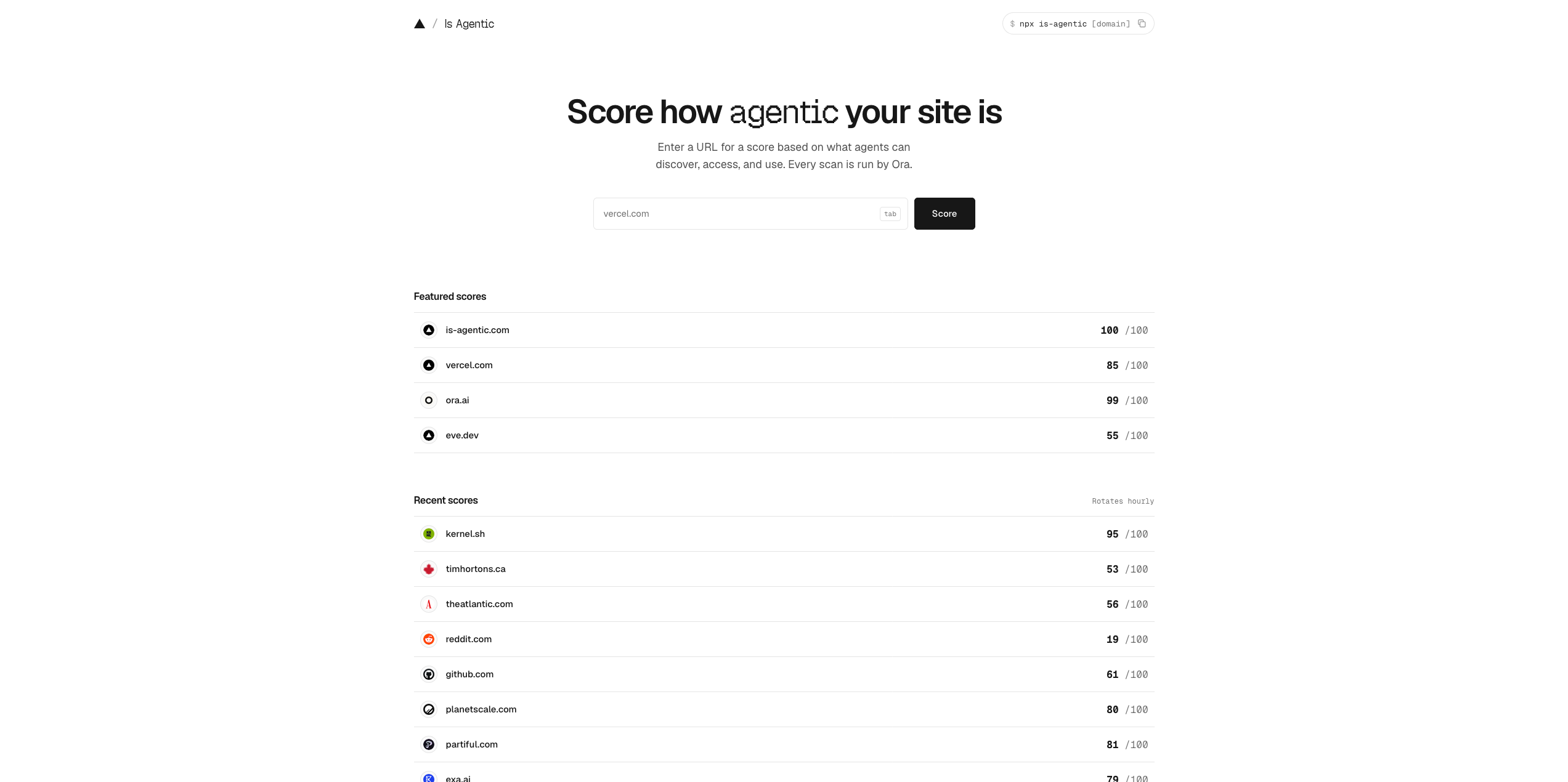
Enter is-agentic.com, the free tool Vercel launched in partnership with Ora in August 2026. It answers a practical question: How agentic is your site? Enter a URL (or run a one-line CLI command) and receive a scored audit with prioritized, evidence-backed fixes.
Unlike generic performance or SEO tools, is-agentic focuses on the public surface that agents encounter. Scans, powered by Ora, evaluate discoverability, accessibility, understandability, and usability. The scoring model is deliberately pragmatic:
Essentials (the bulk of the 100-point scale) cover baseline hygiene—server-rendered or easily extractable content, correct status codes (especially agent-friendly 404s instead of soft 200s with app shells), clear structure, recoverable errors, and usable controls. Recommended checks only activate when the scan finds evidence of APIs, OAuth flows, GraphQL, MCP servers, developer portals, or commerce surfaces. Irrelevant checks are simply excluded. Emerging signals can award a small bonus but never penalize.
The result is a fair score for both a documentation-heavy blog and a full SaaS platform. Reports go further than a number: they show observed agent journeys, cite specific evidence from the scan, and generate concrete recommendations—often ready to paste into a coding agent.
Agentic systems are moving from demos into production workflows. Developers build agents with frameworks that browse the web, call tools via Model Context Protocol (MCP), and chain actions. When an agent fails on a signup flow, misreads documentation, or cannot discover an endpoint because of client-side rendering or missing structured signals, the failure is silent to the site owner—until users or integrations complain.
Vercel, already deep in AI infrastructure (AI SDK, sandboxes, agent tooling, and its own Vercel Agent for code review and production investigations), is applying the same developer-experience mindset here. By open-sourcing the evaluation surface (web UI, CLI via npx is-agentic, public JSON API, Markdown responses, and MCP server), they make the standard inspectable and actionable. Ora contributes the underlying research and live-check engine, which also powers a broader product ranker across discovery, access, usability, and payments layers.
Guillermo Rauch and the Vercel team even dogfooded the tool, iterating on is-agentic.com itself until it reached high scores, underscoring that the criteria target real gaps rather than easily gamed signals.
npx is-agentic yourdomain.com.Common wins include proper HTTP semantics, increasing readable content density, adding clear organization/JSON-LD signals, supporting content negotiation (e.g., Markdown), publishing agent-friendly instructions or llms.txt-style resources where appropriate, and documenting real developer surfaces without overclaiming.
is-agentic.com is part of a broader shift sometimes called agentic optimization or GEO/AEO for agents. Just as mobile-first design and Core Web Vitals became table stakes, agent readiness is emerging as a new dimension of web quality. Sites that remain opaque to agents will increasingly be invisible to a growing class of automated users and workflows.
The tool is free, requires no signup, and exposes machine-readable interfaces so agents can even evaluate sites (or themselves). That closed loop—score, fix with agents, rescore—is exactly the kind of practical infrastructure the agent era needs.
Try it on your own domain. The gaps it surfaces are often ordinary web hygiene with outsized impact for the systems that will increasingly mediate how people and software interact with the internet. In a world where agents act on our behalf, making your site legible to them is no longer optional—it is foundational.