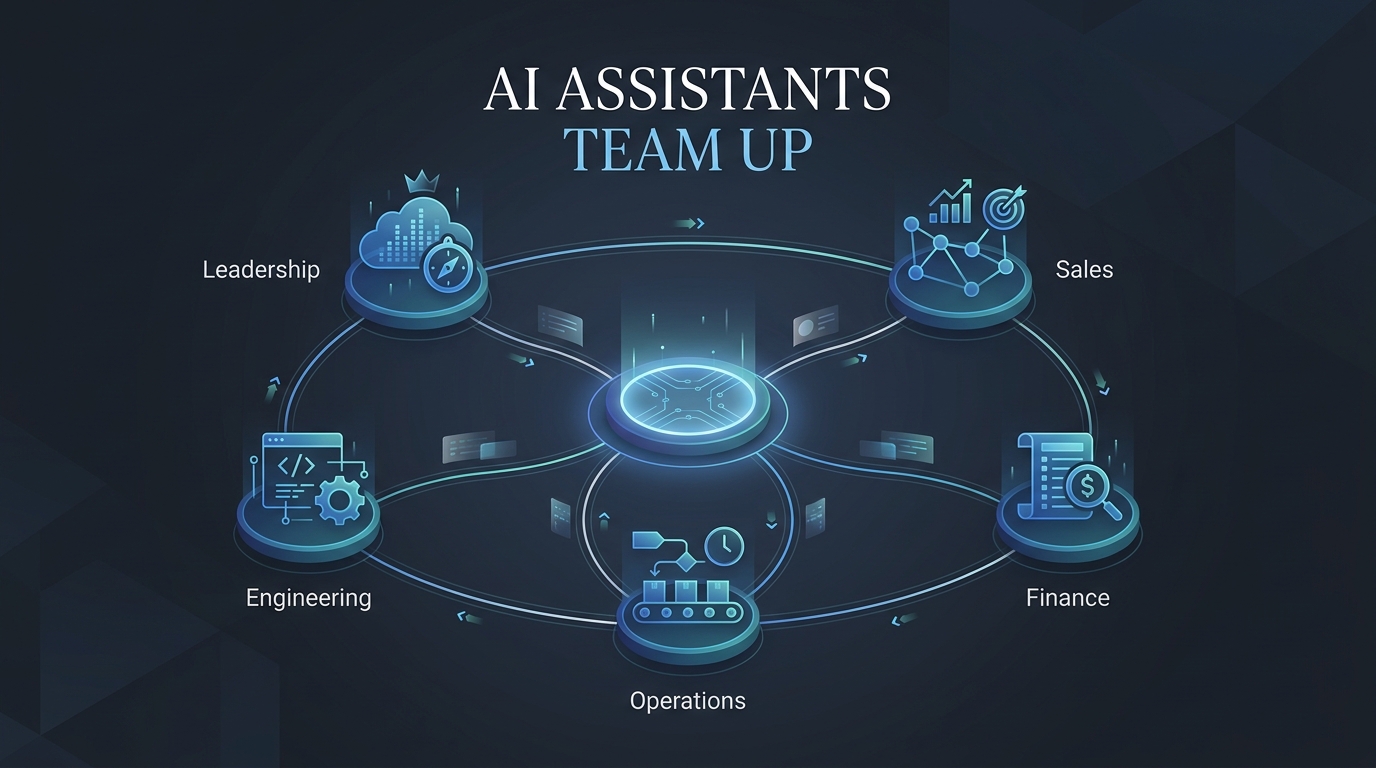
The AI startup's new funding round highlights growing investor interest in collaborative AI agents that can coordinate tasks, share approved information, and automate workflows across entire organizations.
San Francisco-based AI startup Town has raised $108 million in Series B funding at a $1 billion valuation, positioning itself as an emerging contender in the rapidly expanding enterprise AI assistant market.
The round, announced on October 19, 2026, was co-led by Forerunner Ventures and Menlo Ventures, with participation from existing investors including Andreessen Horowitz (a16z) and First Round Capital.
The investment comes just four months after Town's public launch in June, when it announced a $55 million Series A.
But the more consequential development may be what Town is building: AI assistants that do not simply help individual employees but can collaborate with other AI assistants across an organization.
Town is an AI productivity platform that gives employees personalized digital assistants called Townies.
Each Townie connects to its user's workplace applications, including email, calendars, documents, and other business systems.
The assistant uses this context to understand relevant projects, relationships, and responsibilities, helping users handle administrative and operational tasks.
For example, a Townie can assist with organizing an inbox, preparing meeting briefs, drafting correspondence, tracking follow-ups, and gathering information needed for upcoming work.
Unlike a general-purpose chatbot that relies primarily on users supplying prompts and information, Town's approach emphasizes continuously available workplace context.
The goal is to reduce the amount of time employees spend coordinating routine work.
Town's latest development extends its AI assistant model from individual productivity to team coordination.
The company says Townies can now communicate with one another, ask questions, exchange permitted information, and hand off tasks.
Consider a salesperson preparing for an important customer meeting.
Traditionally, the salesperson might need to request updated product information, obtain competitive intelligence, and wait for colleagues to confirm the latest details.
With collaborative AI assistants, the salesperson's Townie could coordinate with other employees' assistants to gather relevant information.
Town says its system is designed to respect existing sharing permissions, request authorization where necessary, and return decisions requiring human judgment to the responsible employee.
The platform also supports interactions with external contacts, including customers, partners, and job candidates, through email and text.
These capabilities reflect a broader movement toward multi-agent systems, in which specialized AI agents coordinate activities instead of working in isolation.
Town is also introducing shared workflows that allow teams to distribute updated operating procedures across employees' assistants.
For example, a sales operations team could update its standard meeting-preparation workflow to include new competitive intelligence.
Rather than requiring every salesperson to modify an individual AI assistant, the updated process could become available across the team's Townies.
The approach aims to make organizational knowledge easier to distribute and operational processes more consistent.
This is an important distinction between AI that helps employees complete individual tasks and AI that coordinates activities across a company.
However, the practical value will depend on whether the system can accurately interpret organizational context, respect permissions, and operate reliably across different applications.
Town was co-founded by Jean-Denis Greze, formerly chief technology officer at Plaid, and Tony Vincent, a former Google applied AI product director.
The startup launched publicly in June 2026 with a $55 million Series A led by Andreessen Horowitz.
According to Town, the company reached a seven-figure annual recurring revenue run rate within weeks of launching.
Since July, it reports that paying customers have increased fourfold and paying teams have grown ninefold.
Town also says thousands of businesses use its AI assistants daily.
These figures suggest rapid early adoption, although the company has not publicly disclosed its current exact annual recurring revenue, profitability, or customer retention.
The $1 billion valuation reflects investor expectations about Town's potential rather than proof of sustained profitability or enterprise-wide productivity improvements.
AI assistants have already demonstrated their ability to help individuals write, summarize, research, and organize information.
But many workplace inefficiencies arise between people rather than within individual tasks.
Employees wait for approvals, request information from colleagues, coordinate responsibilities, and transfer work between departments.
These activities consume time even when each employee is individually productive.
Town is betting that connected AI assistants can reduce this organizational friction.
Menlo Ventures, which co-led the funding round, says its team has been using Town since June to help with inbox management, meeting preparation, and follow-up tasks.
The investment reflects growing confidence that enterprise AI assistants may evolve into a broader operational layer for workplace software.
The model introduces challenges that are especially important for businesses.
An assistant capable of accessing email, calendars, documents, and internal systems may encounter confidential financial information, customer records, business strategies, and sensitive employee communications.
When multiple assistants begin exchanging information, permissions become even more important.
An AI assistant must distinguish between information an employee can access and information that employee is authorized to share with another person or system.
Town says customer organizations own the context their assistants build and can take that information with them if they leave the platform.
The company also states that connected customer data is not used to train AI models by default and that it is SOC 2 Type 2 compliant.
Town uses models from multiple AI providers rather than relying exclusively on one developer.
These are relevant enterprise safeguards, although companies adopting such systems will still need to evaluate security, auditing, reliability, and human approval mechanisms.
The broader significance of Town is not that AI assistants can draft emails or schedule meetings.
Those capabilities are increasingly common.
The important development is the attempt to make assistants operate as a coordinated system across an organization.
If successful, this could change how companies manage information, distribute responsibilities, and execute routine workflows.
For small businesses, coordinated AI agents could make sophisticated operational support more accessible without requiring large administrative teams.
For larger organizations, they could potentially reduce delays caused by fragmented applications, disconnected information, and repeated manual coordination.
However, adoption alone will not establish success.
Town will need to demonstrate measurable productivity gains, dependable cross-team execution, strong permission controls, and sustainable economics.
It also faces growing competition from established enterprise software providers and other AI agent platforms.
Town's $108 million funding round illustrates how investor attention is moving beyond standalone AI chatbots toward systems that perform work across applications and teams.
The company is making a specific bet: that the next major workplace productivity breakthrough will come not merely from making individuals faster but from improving coordination between them.
Whether Town becomes a leading platform remains uncertain.
But its approach raises a consequential question for the future of enterprise software.
What happens when every employee has an AI assistant—and those assistants can work together?
That may be one of the next major tests of agentic AI in the workplace.