The AI industry has spent years making language models bigger. Superwhisper is betting that, for some everyday AI tasks, .
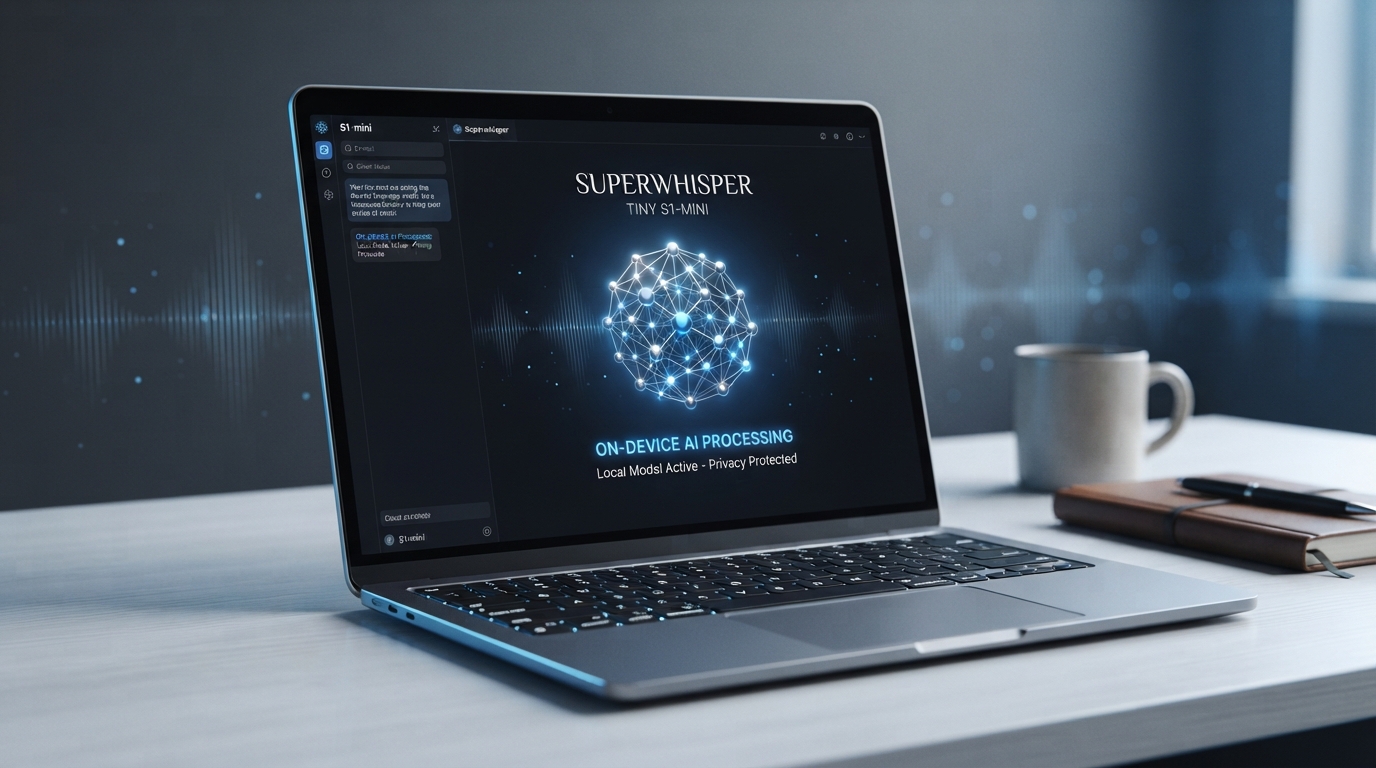
The company has launched S1-mini, its first open-weights language model, built specifically for improving dictated text. At just 0.6 billion parameters and around 462 MB, the model is small enough to run locally on a laptop or phone rather than relying on a cloud server.
And importantly, S1-mini isn't designed to be a general-purpose chatbot.
Instead, it focuses on one job: turning messy speech transcripts into clean, readable text.
That means removing filler words, fixing mistakes, adding punctuation, formatting lists and restructuring dictated content. It can also adjust the writing style using five tone settings, ranging from casual to formal.
The biggest advantage isn't necessarily the model's size. It's where the processing happens.
S1-mini can process transcripts locally, meaning the text doesn't have to be sent to a remote AI server. For people dictating emails, work notes, private conversations or sensitive information, that creates a much stronger privacy story.
Superwhisper already supports on-device voice and language models, with local processing designed to work without an internet connection.
The company is also releasing S1-mini with open weights, making the model available through the Hugging Face ecosystem rather than keeping it entirely proprietary.
S1-mini shows where the AI market could be heading next: specialized models instead of one giant model for everything.
A 0.6B model doesn't need to know how to write software, solve advanced mathematics or act as an autonomous agent if its only task is cleaning up dictation.
By narrowing the problem, Superwhisper can make the model dramatically smaller while still making it useful for its specific workflow.
That could become increasingly important as developers look for AI that runs directly on phones, laptops and other consumer hardware.
There is a trade-off.
S1-mini is currently focused on English text cleanup, rather than being a multilingual general-purpose model or replacing the speech-recognition system itself. The speech still needs to be converted into text before S1-mini can improve it.
So this isn't a replacement for Whisper or other automatic speech-recognition models. It's more like a second layer that takes a rough transcript and turns it into polished writing.
The cloud has dominated generative AI because larger models generally require enormous amounts of computing power.
But S1-mini points toward another possibility: AI that is small enough, specialized enough and efficient enough to live on your device.
For everyday tasks such as dictation, text formatting and personal productivity, users may not need a trillion-parameter model running in a data center.
Sometimes, they just need a tiny model that does one thing extremely well.
The bigger AI story may not always be bigger models. It may be better models that are small enough to run everywhere.