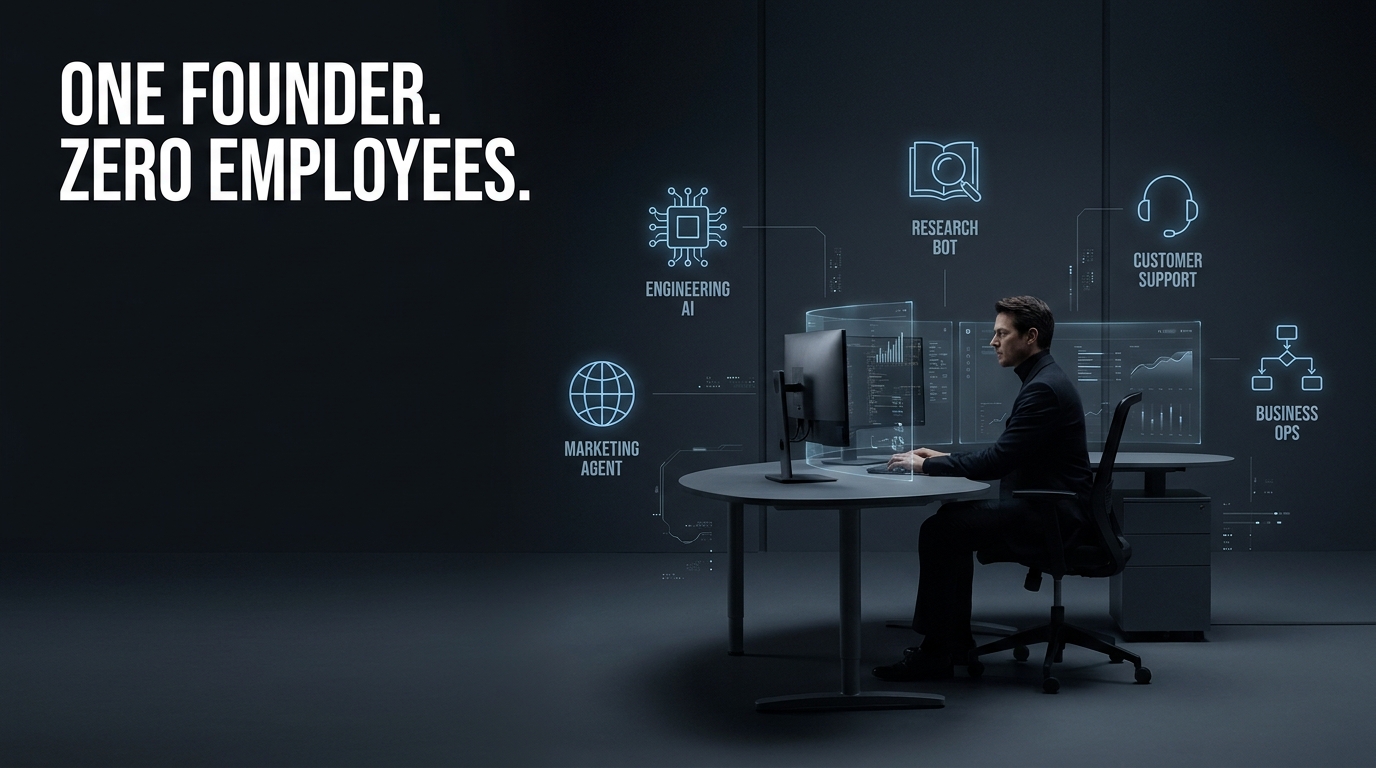
Polsia's rapid growth is putting the idea of the AI-powered one-person company to the test, raising new questions about entrepreneurship, workforce automation, and the economics of AI agents.
The idea of building a multimillion-dollar technology company without employees once seemed unrealistic. But AI startup Polsia is testing how far that concept can go.
Founded by Ben Cera, also known as Ben Broca, Polsia uses AI agents to automate many of the activities traditionally handled by a startup team, including software development, customer support, marketing, research, and business operations.
In May 2026, Cera announced that Polsia had raised $30 million at a $250 million valuation while operating with him as its only human worker.
By September, publicly reported platform figures indicated that Polsia's annualized revenue run rate had climbed to approximately $18.7 million.
The rapid growth is attracting attention for more than its financial milestones. It represents a real-world experiment in whether AI agents can fundamentally change how companies are built and operated.
Polsia describes itself as an AI system capable of building and operating companies.
Rather than requiring entrepreneurs to assemble separate teams for product development, marketing, and operations, the platform coordinates specialized AI agents that execute business tasks.
A user can describe a business idea and instruct the system to begin developing it.
Its agents can write software, conduct market research, create marketing materials, manage advertising activities, and assist with customer support.
The platform also connects to external infrastructure providers and services needed to operate a software business.
The objective is not simply to help entrepreneurs work faster. It is to automate substantial portions of day-to-day business execution.
This makes Polsia part of the growing agentic AI market, where software systems are designed to complete multistep tasks rather than simply respond to individual prompts.
Polsia's growth accelerated during the first half of 2026.
According to the company's founder, the business was approaching a $10 million annual revenue run rate when it announced its $30 million funding round in May.
The investment announcement was notable because Cera said the company had no employees beyond himself.
He also described using Polsia's agents during fundraising, including preparing investor materials, supporting due diligence, and managing correspondence. Cera remained personally involved in final discussions.
The fundraising process therefore became a demonstration of the platform's underlying proposition: that AI agents can coordinate work traditionally performed by multiple employees.
Investors including Sound Ventures, True Ventures, and Offline Ventures backed the company, according to the founder's announcement.
The financing valued Polsia at $250 million, reflecting investor interest in the possibility of substantially more automated businesses.
However, valuation and fundraising do not establish profitability or long-term commercial success.
Polsia's reported financial performance is impressive, but interpreting the numbers requires care.
In September 2026, third-party reporting based on the company's public metrics indicated approximately $18.7 million in annualized revenue run rate.
Of that amount, roughly $11 million represented recurring subscription revenue.
The remainder included other revenue categories, such as task-related purchases and additional platform transactions.
This distinction matters.
Annual recurring revenue, or ARR, generally refers to recurring revenue normalized over a year. An annualized revenue run rate can instead estimate yearly sales by multiplying a recent period's total revenue, even when some transactions are not recurring.
Consequently, Polsia's reported overall run rate should not automatically be described as subscription ARR.
The company's results are also based primarily on public operational metrics and founder disclosures rather than independently audited financial statements.
Nevertheless, the reported scale is significant for a company operating with one human founder.
Traditional startups tend to expand their workforce as operational complexity increases.
Software engineers build products. Marketing teams acquire customers. Customer support personnel resolve problems. Finance and operations teams manage essential workflows.
Polsia attempts to automate many of these functions through coordinated agents.
Its model suggests that the relationship between employee count and business scale may be changing.
In principle, a founder who can direct AI agents effectively could launch products, test ideas, and manage operations without hiring a conventional team for every task.
This could lower the cost of experimentation and make entrepreneurship more accessible.
But automation does not eliminate the economic cost of operating a business.
AI inference, cloud hosting, third-party services, advertising, customer acquisition, and payment infrastructure all require spending.
As AI agents take on more work, these costs become increasingly important to a company's financial performance.
A one-person company is not necessarily a low-cost company.
Polsia's business model also faces significant challenges.
Customer retention is one.
In a May 2026 interview on The Next New Thing, Cera discussed substantial early customer churn and the costs associated with operating AI infrastructure.
The interview also raised questions about how many businesses created using Polsia generate meaningful revenue.
These issues are important because a platform may experience rapid growth from entrepreneurial experimentation without every customer establishing a successful, lasting business.
There are also questions about the reliability of autonomous agents.
AI systems can generate software and marketing materials quickly, but their output still requires quality control. Errors in deployment, customer communications, financial operations, or advertising can create real consequences.
Autonomous execution therefore introduces new demands for monitoring, accountability, and risk management.
Polsia's experience illustrates both the opportunity and the operational challenges of running companies through software agents.
The broader significance of Polsia extends beyond one startup.
For decades, building a substantial technology company typically required assembling a team, raising capital, and creating organizational structures to coordinate human work.
AI agents could alter that model.
A single entrepreneur might increasingly coordinate multiple automated capabilities, with human expertise concentrated on strategy, relationships, oversight, and decisions that require judgment.
This would not necessarily eliminate traditional companies or human employment.
Instead, it could introduce new organizational structures where a smaller human workforce manages a larger body of automated operational activity.
For small and medium-sized businesses, the implications are particularly relevant.
Entrepreneurs who previously lacked the resources to hire developers, marketers, or operations teams may gain access to some of those capabilities through software.
At the same time, growing reliance on external AI providers could introduce new forms of technological and financial dependence.
Polsia offers one of the more visible experiments in AI-native company operations.
Its reported revenue growth and substantial fundraising demonstrate interest in the concept, but important questions remain unresolved.
Can the company sustain growth while retaining customers?
Will operating margins improve as AI infrastructure becomes more efficient?
Can its agents consistently perform complex tasks without extensive human intervention?
And can customers using the platform establish commercially successful businesses of their own?
The answers will help determine whether the model becomes a durable approach to entrepreneurship or remains most effective for particular types of businesses.
For now, Polsia's story highlights a potentially consequential development in artificial intelligence.
AI is moving from assisting employees with individual tasks toward coordinating entire business workflows.
The important question may no longer be how many people are required to start a company, but how effectively one person can direct the combination of human judgment and automated intelligence needed to operate it.