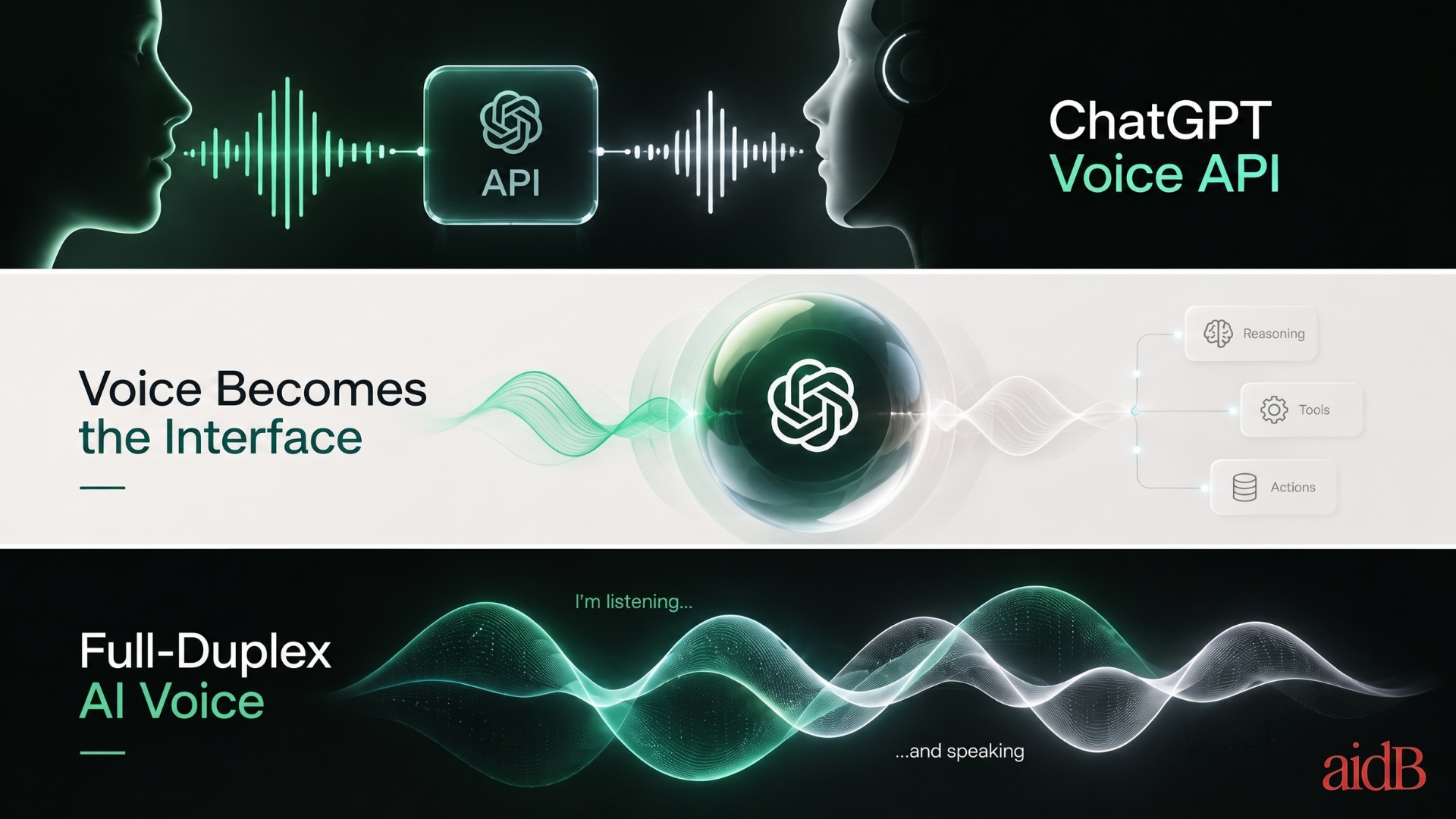
GPT-Live-1 is now available to developers.
The same voice system behind ChatGPT Voice—the one that can listen while it talks—is no longer confined to ChatGPT.
As of September 10, 2026, GPT-Live-1 is an API product.
And the important part is not simply that developers now have access to another voice model. It is how OpenAI wants developers to use it.
GPT-Live-1 is designed to become the voice layer sitting in front of your existing models, agents, tools, and phone systems.
That distinction matters.
Most production voice agents still behave like badly run meetings: one person talks, the system waits, the system responds, then the person talks again.
Humans do not communicate like that.
We interrupt. We pause. We hesitate. We talk over noise. We change direction halfway through a sentence. Sometimes we expect the other person to keep listening while they are already doing something for us.
GPT-Live-1 is built for that messier reality.
Traditional voice agents usually look something like this:
It works.
But every step adds latency. Every handoff creates another place where timing can fall apart. Interruptions become special cases that developers have to engineer around.
And when the bot says, “Please hold while I look that up,” what it is really telling you is that the conversation and the work cannot happen at the same time.
OpenAI’s earlier Realtime models already reduced some of this friction by moving toward native speech-to-speech interaction.
GPT-Live-1 takes the architecture in a more interesting direction.
The live model handles the conversation: listening, speaking, interruptions, silence, backchannels, and timing.
A backend model or agent handles the hard work: reasoning, tool calls, searches, bookings, code, and whatever else your application actually needs to do.
So the caller can keep talking while the backend is working.
When the result comes back, GPT-Live-1 can bring it into the same conversation without forcing everything back into a rigid turn-by-turn flow.
That is the architectural bet.
Voice is no longer the whole agent. Voice becomes the interface.
The brain behind it can be whatever system you already trust.
GPT-Live-1 first appeared inside ChatGPT in July 2026, when it replaced Advanced Voice Mode for most users.
Paid users received GPT-Live-1. Free users received GPT-Live-1 mini.
That was the consumer launch.
This is the developer launch.
GPT-Live-1 is now exposed through live API sessions, with connections available through WebRTC for browsers, WebSockets for server applications, and SIP integrations for telephony.
The ecosystem is already forming around it, with partner paths involving platforms including Telnyx, Twilio, LiveKit, and Daily/Pipecat.
Telnyx, one of the launch partners, is also positioning the model for outbound calling, including higher-quality 16 kHz PCM audio rather than relying entirely on the narrowband sound most people associate with traditional phone systems.
Developers can connect the intelligence behind the voice layer in two main ways.
With Responses delegation, OpenAI can call a hosted Responses model and provide it with the relevant conversation context.
With client delegation, your own application handles the backend. That could be another model, your existing agent framework, an internal service, or a custom orchestration layer.
The separation is important.
Put conversational behavior and speaking style in the live model.
Keep business logic, policies, workflows, and heavier reasoning in the backend.
That is really what GPT-Live-1 is selling.
OpenAI is not just selling a better-sounding voice.
It is selling fewer awkward silences.
Speak, the language-learning company, says GPT-Live-1 reduced interruptions during thinking pauses by almost 80% compared with turn-based tutors.
That matters more than it sounds.
A learner pauses because they are thinking. A traditional voice bot interprets the silence as the end of the turn and jumps in. Suddenly the tutor feels impatient.
A system that knows when not to speak can feel dramatically more natural.
Yelp is also testing the model across Yelp Host, which handles restaurant calls, and Hatch, its service-business booking product.
Yelp CTO Alex Levy says callers are speaking in longer, more natural sentences.
That might be one of the more useful metrics in the entire launch.
If people stop talking to your voice agent like they are filling out a form, the interface is probably working.
Yelp also says the system can recognize tone and move between languages, potentially making restaurant and service calls much less brittle when callers do not follow the expected script.
Other launch examples point in the same direction.
Support company Fin is exploring phone conversations that feel less scripted.
Cognition is using voice to let developers talk through engineering work with Devin instead of interacting only through text.
And one healthcare developer says moving away from a traditional cascaded voice pipeline reduced its voice-related codebase by around 80%.
That last number gets to another part of the pitch.
Better voice interaction is useful.
Deleting huge amounts of glue code may be even more useful.
Launch coverage points to significant improvements over GPT-Realtime-2.1.
Reported figures include roughly 80.1% versus 45.4% on full-duplex interaction, 0.8 seconds versus 1.4 seconds for turn-taking latency, 87% versus 60% on tool-calling accuracy, and 32% versus 12.4% on one banking voice-support benchmark.
As always, vendor benchmarks are best treated as directional rather than absolute truth.
But the pattern is clear.
Voice models were already good at speaking.
The harder problem was maintaining a natural conversation while interruptions, tool calls, background noise, and real-world timing all happened at once.
That appears to be where OpenAI concentrated much of the work.
GPT-Live-1 can also output ASR transcripts and response text, handle alphanumeric information, support keyword biasing, and expose turn detection when applications still need explicit conversational boundaries.
The available voice selection has also expanded beyond the relatively small set associated with earlier realtime products, with broader accents and dialects represented in launch material.
Custom voices remain a sales-led offering.
The model itself is focused on audio and text. Image and video are not part of GPT-Live-1.
GPT-Live-1 costs $0.05 per minute for the live voice layer, billed by the second.
So a 90-second conversation costs about $0.075 for GPT-Live-1 itself.
But that is not necessarily your total cost.
Whatever backend model you delegate to still costs money. Tool calls still cost money. Longer reasoning still costs money.
Silence also counts.
If the session stays open, the meter is still running.
So developers will need to treat session management as part of the product architecture rather than leaving live sessions hanging around unnecessarily.
Rate limits are based on concurrent sessions rather than token throughput, ranging from 25 concurrent sessions at Tier 1 to as many as 500 at Tier 5.
There is no free API tier.
Is $0.05 per minute cheap?
That depends on what you compare it with.
Against the raw model component of some voice stacks, it may look expensive.
Against a three-stage STT → LLM → TTS architecture that requires significant engineering just to handle interruptions properly, some teams may happily pay more for the model if it means maintaining far less infrastructure.
One of the most interesting themes in the launch is not lower token cost.
It is less code.
| Approach | Best for |
|---|---|
| GPT-Live-1 | Natural full-duplex conversation with a separate backend or agent you already control |
| Realtime API | One model handling speech, reasoning, and tools inside the same realtime session |
The simplest way to think about it is this:
If you already have a capable agent with tools and workflows, GPT-Live-1 becomes the microphone and the mouth.
If you want one speech-to-speech model handling most of the intelligence itself, Realtime may remain the simpler architecture.
And if your compliance or application requirements demand that every transcript be inspected before anything gets spoken back, the traditional pipeline still has a reason to exist.
The more interesting story is where OpenAI thinks voice is going.
Voice is becoming the front door to longer-running agent work.
ChatGPT already works this way.
The live model can handle conversational timing and lightweight interaction while searches, deeper reasoning, and tool calls happen elsewhere.
GPT-Live-1 essentially makes that architecture programmable.
The Codex examples are another clue.
Instead of stopping your work to type a request, you can talk through a repository, ask a question, get a short spoken response, change direction, and keep moving while the agent continues working.
That is why telephony support may ultimately matter more than another impressive voice demo.
Restaurant reservations. Repair scheduling. Customer support. Collections. Tutoring. On-call engineering. Appointment booking.
These workflows already happen over the phone.
The problem was never simply:
Can an AI book a table?
The harder question was:
Can someone talk naturally while the AI is booking the table?
GPT-Live-1 is OpenAI’s attempt to answer that.
If you are evaluating GPT-Live-1, “make it say hello” tells you almost nothing.
Test the situations that usually break voice agents:
Those are the failure modes yesterday’s bots struggled with.
They are also exactly where GPT-Live-1 is supposed to be different.
GPT-Live-1 will not automatically make every voice agent good.
A bad prompt is still a bad prompt. A broken tool is still a broken tool. Poor orchestration can still turn an impressive model into a polite disaster.
What OpenAI is trying to remove is one of the biggest excuses developers have had for years:
the voice layer itself cannot keep up with a human conversation.
Now the conversation can keep moving while the backend catches up.
And that may be the real significance of this launch.
The question is no longer whether full-duplex AI voice is ready to become part of production workflows.
The more interesting question is:
Which of your existing workflows has been waiting for a mouth that can listen?

| STT → LLM → TTS | Maximum control over every stage, especially when transcripts must be inspected or transformed before speech is returned |