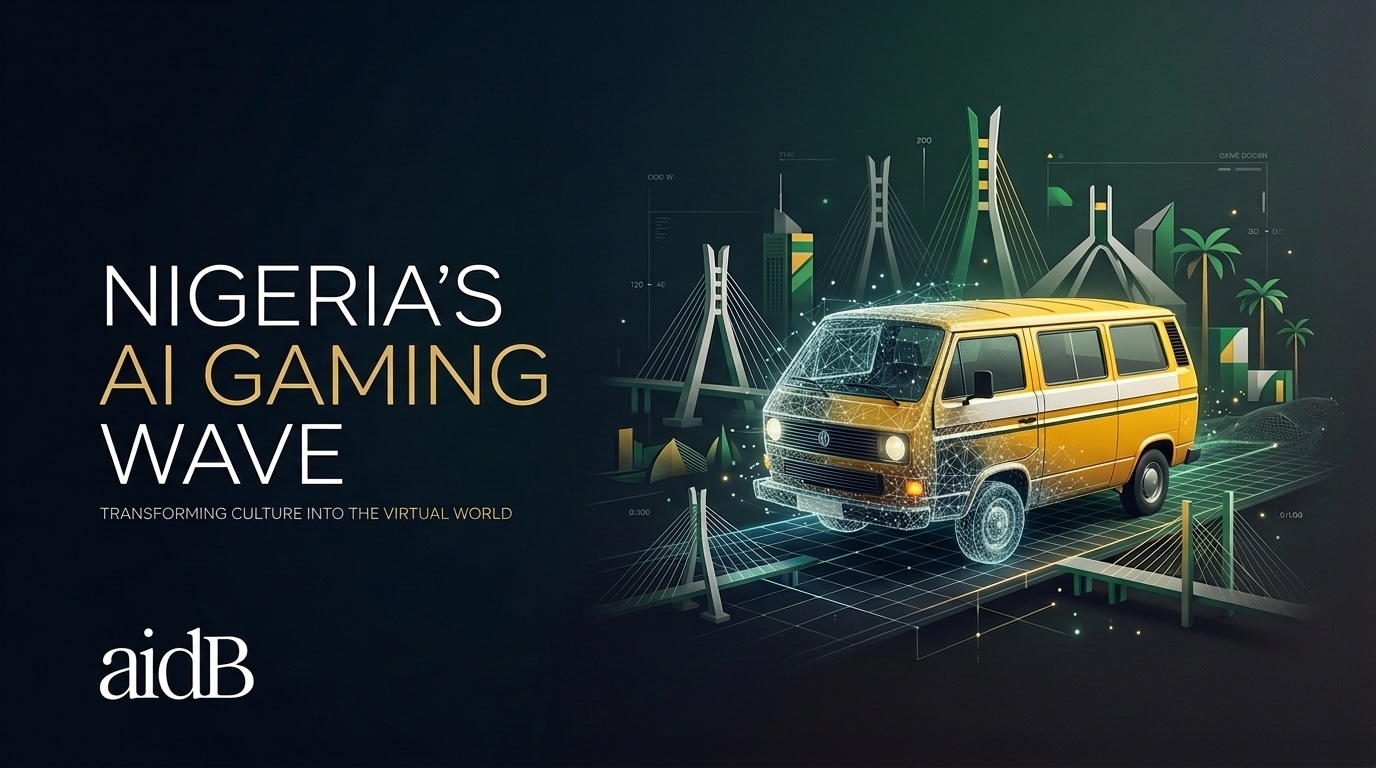
AI-assisted development, browser distribution and local culture are creating a new wave of Nigerian games. Lagos Life may be the breakout hit, but the bigger story is what happens when culturally specific game ideas suddenly become cheap enough to build and easy enough to distribute.
Something unusual is happening in Nigerian gaming.
On October 1, 2026, software developer Shalom Rayhamen launched Lagos Life, a browser-based life simulator built around recognizably Nigerian experiences: earning naira, finding work, paying rent, riding danfos, navigating unreliable electricity and building a virtual life in Lagos.
There was no large studio launch.
No console release.
No app-store download.
Players clicked a link and entered a virtual Lagos.
Within three days, Lagos Life said it had passed one million players. By October 10, the company was reporting seven million players and more than 36 million visits. Days earlier, Vatar—the company formed around the game—announced a $500,000 funding round at a reported $10 million valuation. Those player figures are company-reported rather than independently audited, but the wider attention surrounding the launch is unmistakable.
The obvious story is that Lagos Life went viral.
The more interesting story is why a project like this could be built, distributed and monetized so quickly—and why several other Nigerian developers are arriving at similar ideas at almost the same time.
Nigeria may be giving us an early look at what game development looks like when three barriers fall together:
AI dramatically reduces the cost of prototyping. Browser distribution removes installation friction. And local culture becomes an advantage rather than something developers have to translate for a global audience.
That combination could matter far beyond one viral game.
Part of Lagos Life's appeal is easy to understand.
It doesn't simply take a generic life simulator and place a Nigerian flag in the background.
Lagos itself becomes part of the game's mechanics.
Players encounter danfos, generators, rent, jobs, nightlife and recognizable locations. The result feels familiar enough that screenshots and experiences become inherently shareable among people who understand the references.
Rayhamen told reporters that she started building the project at around 9 p.m. on September 30 and released its initial version the following morning. She said she used Anthropic's API for research and coding.
That “built overnight with AI” headline understandably attracted attention.
But focusing only on how quickly it was coded misses something important.

AI didn't invent Lagos.
It didn't create the shared experience of danfo rides, generators, rent pressure, traffic or local nightlife.
The technology lowered the barrier between having those cultural observations and turning them into an interactive product.
That distinction may prove much more consequential.
Five days before Lagos Life launched, Nigerian developer Opeyemi Adeniran released Danfo Run, originally launched as Lagos Run.
The browser game has a straightforward premise: drive a Lagos danfo, pick up passengers, collect fares, navigate traffic and chase a high score.
Adeniran developed the project in his spare time while living in Berlin, drawing partly on memories of Lagos. He reportedly expected only a few hundred players. Instead, the game attracted more than 140,000 players during its first week and reached people in 145 countries, according to his developer profile.
Rayhamen has described Lagos Run as one of the inspirations behind Lagos Life.
That makes the sequence particularly interesting.
One developer ships a culturally specific browser game.
People share it.
Another developer sees the response and realizes a much bigger Nigerian game might be possible.
Days later, that second game reaches millions of reported players.
Other developers start experimenting too.
That is how an ecosystem can begin—not through a government strategy document or a billion-dollar publisher, but through visible proof that people want to play locally rooted ideas.
Nigeria's game-development history didn't begin in October 2026.
Developers and studios have experimented with Nigerian stories, cities and transportation for years. Even the danfo has appeared repeatedly as a source of inspiration.
What has changed is the economics of experimentation.
Traditional game development can demand programmers, designers, artists, animators, sound engineers, testers and considerable production time before anyone knows whether the central idea is fun.
AI doesn't eliminate those disciplines. Serious games still benefit enormously from specialists.
But AI can allow one developer—or a very small team—to prototype something that previously required considerably more resources.
Code can be generated or debugged with an AI assistant.
Concept art can be produced rapidly.
Interfaces can be prototyped.
Dialog can be drafted.
Game mechanics can be iterated.
Assets can be created or transformed.
Documentation can be generated.
A small developer increasingly gets access to capabilities that resemble parts of a miniature studio.
That changes the question from:
“Can I justify spending months and a significant budget building this?”
to:
“Can I make a playable version quickly enough to find out whether anyone cares?”
For culturally specific games, that difference is enormous.
The second ingredient is distribution.
Lagos Life and Danfo Run are browser games.
That sounds like a technical detail. It isn't.
Imagine discovering a funny Nigerian game on X or receiving it in a WhatsApp group.
With a browser game, the journey can be:
See post → tap link → play.
Compare that with:
See post → open app store → search → check storage → download → install → perhaps create account → finally play.
Every additional step loses potential players.
Browser-first distribution is therefore particularly compatible with social virality.
Games Industry Africa has identified the combination of AI-assisted development, culturally familiar experiences and frictionless browser access as a defining feature of the current Nigerian wave.
The wider African market makes that even more relevant.
Carry1st and Newzoo forecast Africa will reach approximately 406.25 million players in 2026, up almost 10% year over year. They estimate the continent's games market at about $1.98 billion, with mobile accounting for 81.8% of revenue. Nigeria alone is forecast to generate about $226.6 million in games revenue this year.
The infrastructure story is therefore not “Africa needs everyone to buy gaming PCs.”
The dominant device is already in people's pockets.
A lightweight game that can spread through a link fits that reality remarkably well.
When AI tools become widely available, access to AI itself stops being a competitive advantage.
Everyone can eventually use Claude.
Everyone can eventually generate game assets.
Everyone can eventually ask an agent to help write code.
What doesn't become commoditized as easily is cultural insight.
A developer who understands Lagos knows why a danfo driver drifting into a BRT lane is funny—or risky.
They understand how a conductor calls stops.
They know what go-slow feels like.
They know what NEPA means emotionally without needing an explanatory paragraph.
They understand the social dynamics around rent, nightlife, food, universities, football viewing centres and Nigerian bureaucracy.
These aren't simply visual themes.
They contain rules, conflict, progression and humor.
In other words, they already contain game mechanics.
The Nigerian opportunity may therefore not be to use AI to make cheaper versions of games produced elsewhere.
It may be to use AI to make games that large international studios would never have thought to build in the first place.
Consider a Lagos danfo.
Without changing anything, it already contains a surprisingly complete game system.
There is a destination.
There are routes.
Passengers create objectives.
Bus stops become checkpoints.
Fares become currency.
Fuel becomes resource management.
Traffic becomes an obstacle system.
BRT lanes introduce risk and reward.
Okadas, kekes and other vehicles create dynamic hazards.
Traffic enforcement introduces penalties.
Vehicle customization creates progression.
That's why different developers can look at the same real-world phenomenon and discover different games inside it.
Danfo Run turns that idea into a fast, accessible driving challenge.
Lagos Life incorporates the danfo as part of a much broader virtual-Lagos simulation.
And DanfoRush, a browser-based bus-driving simulator developed by Montorox, takes another approach: four Lagos routes, passenger loading at bus stops, fares, fuel, go-slow, BRT lanes, traffic enforcement, vehicle customization and an in-game Danfo FM soundtrack.
The significance isn't that Nigeria suddenly needs more danfo games.
It's that one culturally familiar object can support several entirely different interpretations.
That is what healthy creative ecosystems do.
Disclosure: DanfoRush is developed by Montorox, the company behind TheAIDB.net.
Player numbers generate headlines.
Business models determine whether studios survive.
Lagos Life is interesting here too.
Rather than depending exclusively on conventional game purchases, Vatar has experimented with turning the virtual city itself into commercial inventory.
Businesses can reportedly advertise through virtual billboards and branded spaces. Musicians can promote music inside virtual venues. The company has also discussed corporate partnerships and other commercial integrations. Vatar says it had earned and contracted more than $170,000 shortly after launch, although, like its player totals, that figure comes from the company.
Even more interestingly, Lagos Life has announced plans for APIs that would allow other developers to create games connected to Lagos Life accounts and its virtual economy.
If that works, the ambition changes considerably.
Lagos Life would no longer simply be a game.
It could become a small platform for Nigerian interactive experiences.
That remains an ambition rather than a proven outcome, but it is worth watching.
There is an important counterpoint to all the excitement.
When the cost of creation falls, the amount of mediocre content rises too.
We are likely to see many more games that are technically playable but forgettable.
AI can generate code.
It can create graphics.
It can produce music, dialogue, textures and environments.
But games still require judgment around pacing, balance, progression, difficulty, responsiveness, reward loops, retention and fun.
This distinction is now being acknowledged at the highest levels of the global game industry.
On October 7, Google and Unity announced a partnership around a new AI gaming platform. Google's experimental Playground already allows people to create playable browser games with natural-language prompts, while Unity Spark is planned as a broader creation environment.
Unity CEO Matt Bromberg made the challenge explicit: rapidly recreating something that already exists does not make someone a great game designer. The goal, he argued, should be helping more people create genuinely original interactive experiences.
That distinction will matter enormously in Nigeria too.
AI solves part of the production problem.
It does not solve the taste problem.
And when thousands of games become easy to make, taste becomes more valuable, not less.
It is too early to know whether Lagos Life becomes a durable gaming company, a broad virtual-world platform or a spectacular viral moment.
The same uncertainty applies to most of the browser games appearing around it.
But something has already changed.
Developers now have visible evidence that Nigerians will click, play and share games built around Nigerian experiences.
Investors have visible evidence too.
Brands have seen that virtual Nigerian environments can attract attention.
Other developers have seen that a culturally specific idea doesn't necessarily restrict a game's audience. Danfo Run reaching players across scores of countries is an example of how something intensely local can still travel globally.
This matters because creative industries grow partly through permission.
Someone succeeds publicly.
Others realize they're allowed to try.
The least interesting outcome would be dozens of Lagos Life clones.
The much more exciting possibility is developers applying the same approach to entirely different cultural systems.
Imagine games built around running a Nigerian restaurant.
Managing an owambe.
Surviving university life.
Building a football academy.
Running a market stall.
Navigating NYSC.
Operating a logistics company in Lagos traffic.
Building a music career from local shows to global stages.
Managing a Nollywood production.
Running an election campaign.
Building a city from the perspective of an informal transport operator.
Some would be silly.
Some would fail.
A few could become remarkable.
The point is not that every Nigerian experience needs to become a game.
The point is that developers can now afford to discover which ones should.
Games may also increasingly become a medium for companies that don't think of themselves as gaming businesses.
A brand could commission a lightweight game instead of another display ad.
A musician could release a playable world around an album.
A Nollywood studio could create an interactive experience around a film.
A tourism board could let people explore a stylized version of a city.
A sports club could build a mini-game around supporters.
An educational company could turn local history into interactive storytelling.
An ecommerce company could let customers unlock discounts through gameplay.
As production becomes cheaper, “game” begins to overlap with website, campaign, community, story and advertisement.
That creates opportunities not only for game studios, but for African creative agencies, developers, designers, musicians, storytellers and brands.
The Nigerian moment is happening while the global technology industry is aggressively lowering the barrier to game creation.
Google's Playground allows non-programmers to describe 2D or 3D browser games in natural language and generate playable experiences. Games can then be shared through links or published to a gallery.
Google and Unity say their broader partnership is intended to put game creation into the hands of millions of additional creators.
Roblox, Meta and a growing ecosystem of specialist AI-game tools are moving in the same direction.
That means the technological advantage will eventually spread everywhere.
And that brings us back to Nigeria.
If AI gives millions of creators access to roughly similar production capabilities, the differentiator becomes:
What do you understand that everyone else doesn't?
For African developers, culture may be one answer.
Generative AI has an obvious failure mode.
Because models learn from enormous datasets of existing material, they can easily pull creators toward familiar aesthetics.
Generic fantasy games.
Generic cyberpunk cities.
Generic mobile interfaces.
Generic characters.
Generic stories.
That would be an enormous missed opportunity.
The most compelling lesson from Lagos Life isn't:
“AI can help Nigerians make games that look like games from everywhere else.”
It's closer to the opposite:
AI can reduce the cost of building experiences that are so culturally specific they might never have survived a traditional greenlight process.
A danfo doesn't need to become a generic bus.
Lagos doesn't need to become “African cyberpunk city.”
Accra doesn't need to become a substitute for somewhere else.
The specificity is the advantage.
The first phase of this moment was about visibility.
A browser game goes viral.
People tweet about it.
Millions reportedly try it.
Investors notice.
Developers respond.
The second phase will be much harder.
Can these games retain players?
Can studios build communities?
Can they create durable intellectual property?
Can monetization grow without destroying the experience?
Can developers move from rapid prototypes to well-designed games?
Can successful experiments become sustainable African game companies?
Those questions will matter more than launch-week traffic.
But every industry needs moments when people suddenly pay attention.
Nigeria appears to be having one now.
The most important takeaway isn't that Lagos Life reached an extraordinary number of players.
It's that the distance between “someone should make a game about this” and “here's the link—play it” is collapsing.
For a country with enormous cultural output, a young digital population and a rapidly growing gaming audience, that is a very interesting development.
And Nigeria may only be the beginning.
AI isn't removing the need for game developers.
It's changing who gets to become one.
Browser distribution isn't replacing app stores and consoles.
It's making experimentation dramatically easier.
And local culture isn't a constraint developers need to overcome.
It may become one of their strongest competitive advantages.
The Lagos Life explosion gave Nigeria's emerging game-development community something invaluable:
proof of attention.
What Nigerian creators build with that attention next will tell us whether October 2026 was simply a viral moment—or the beginning of a much larger African gaming movement.
About TheAIDB: TheAIDB covers practical developments in artificial intelligence, emerging AI tools and the businesses, creators and industries being reshaped by them.