The AI chip race is getting more interesting — and Google is putting even more money behind custom silicon.
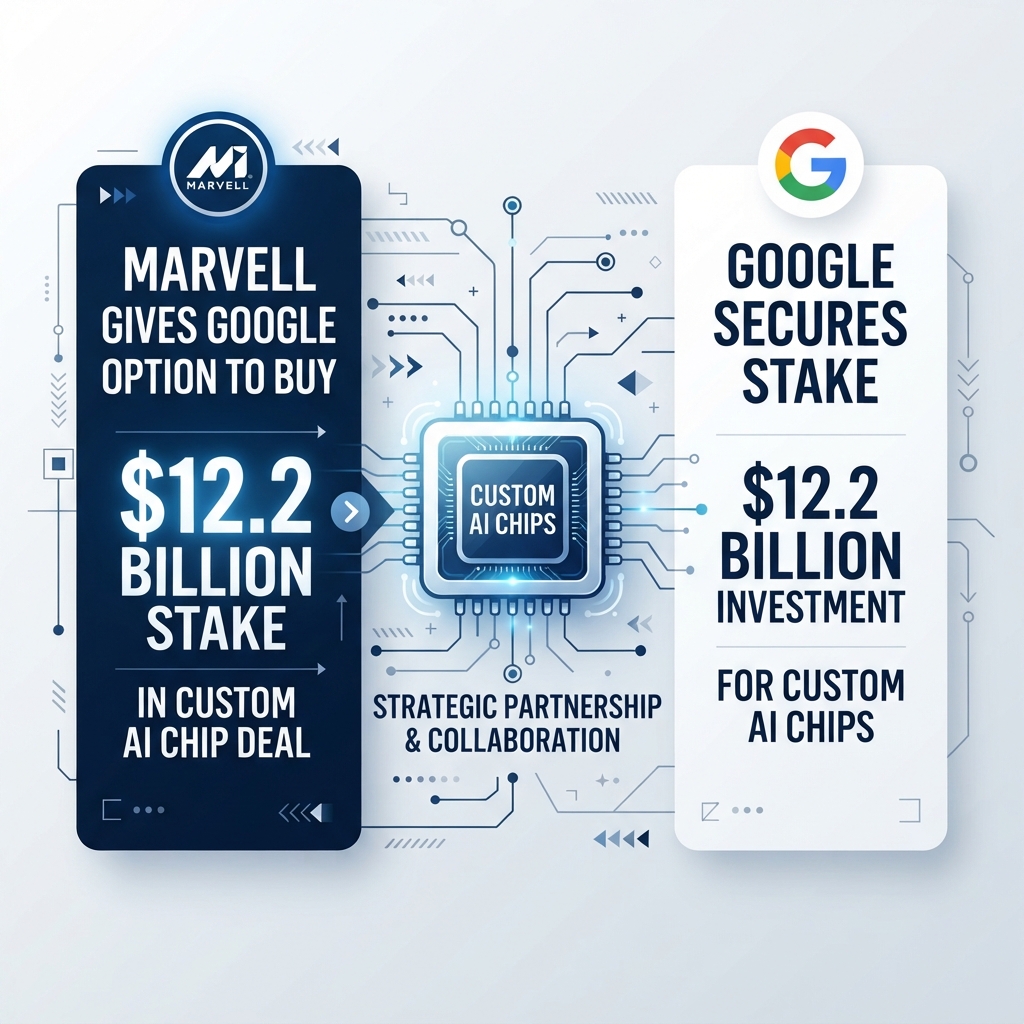
Marvell Technology has entered a new agreement with Google to develop a broad range of custom chips designed around Google's Tensor Processing Unit (TPU) ecosystem. As part of the deal, Marvell has issued Google a warrant to purchase up to 58.97 million shares at $206.58 each, worth roughly $12.18 billion if fully exercised.
But this isn't simply Google buying a $12 billion stake today.
Most of the warrant becomes available as Google hits agreed purchasing targets through fiscal 2033. In other words, Google's potential ownership in Marvell is directly tied to how much custom silicon it buys from the company.
The partnership covers more than just AI processors. Marvell will work on AI inference accelerators, storage and networking components, memory-interface controllers, and near-memory computing technologies designed to support Google's growing AI infrastructure.
And there's an immediate market signal here.
Marvell shares jumped more than 11% in premarket trading, while Broadcom — Google's major custom AI-chip partner — fell more than 2%. Broadcom already has a long-term agreement with Google covering future generations of custom AI chips through 2031.
Google is increasingly building its AI infrastructure around custom chips rather than relying entirely on Nvidia's GPUs.
That's a major shift because custom silicon can be designed specifically around Google's workloads, potentially improving performance, efficiency and cost for massive AI operations.
And Google isn't alone. Amazon, Microsoft, Meta and other hyperscalers are all investing heavily in custom AI hardware.
The bigger story is that AI infrastructure is becoming a multi-chip ecosystem rather than an Nvidia-only market.
For Marvell, the deal could lock in a huge long-term customer and accelerate its custom-silicon business.
For Google, it creates another strategic supplier for the hardware powering its AI ambitions while giving it greater control over its chip roadmap.
And for the broader AI industry, increased competition among chip designers could eventually mean more specialized and efficient hardware.
The $12.2 billion figure can be misleading.
Google isn't handing Marvell $12.2 billion today. The warrant's full value depends on Google meeting purchasing commitments over several years.
There's also intense competition. Broadcom remains a major Google chip partner, while Nvidia continues to dominate the broader AI accelerator market.

The AI boom is moving beyond the model layer.
The next battle is happening underneath it — across chips, memory, networking, storage and data-center infrastructure.
Google's potential $12.2 billion investment in Marvell shows just how strategically important custom silicon has become.
The AI race is no longer just about who builds the smartest model. It's increasingly about who controls the hardware that runs it.