William Zhang, president of Huawei's healthcare business unit, said the company is already working with hospitals on clinical AI projects and expects more collaborations with pharmaceutical companies to emerge as its medical AI capabilities mature. For now, most of these partnerships are focused on domestic Chinese drugmakers.
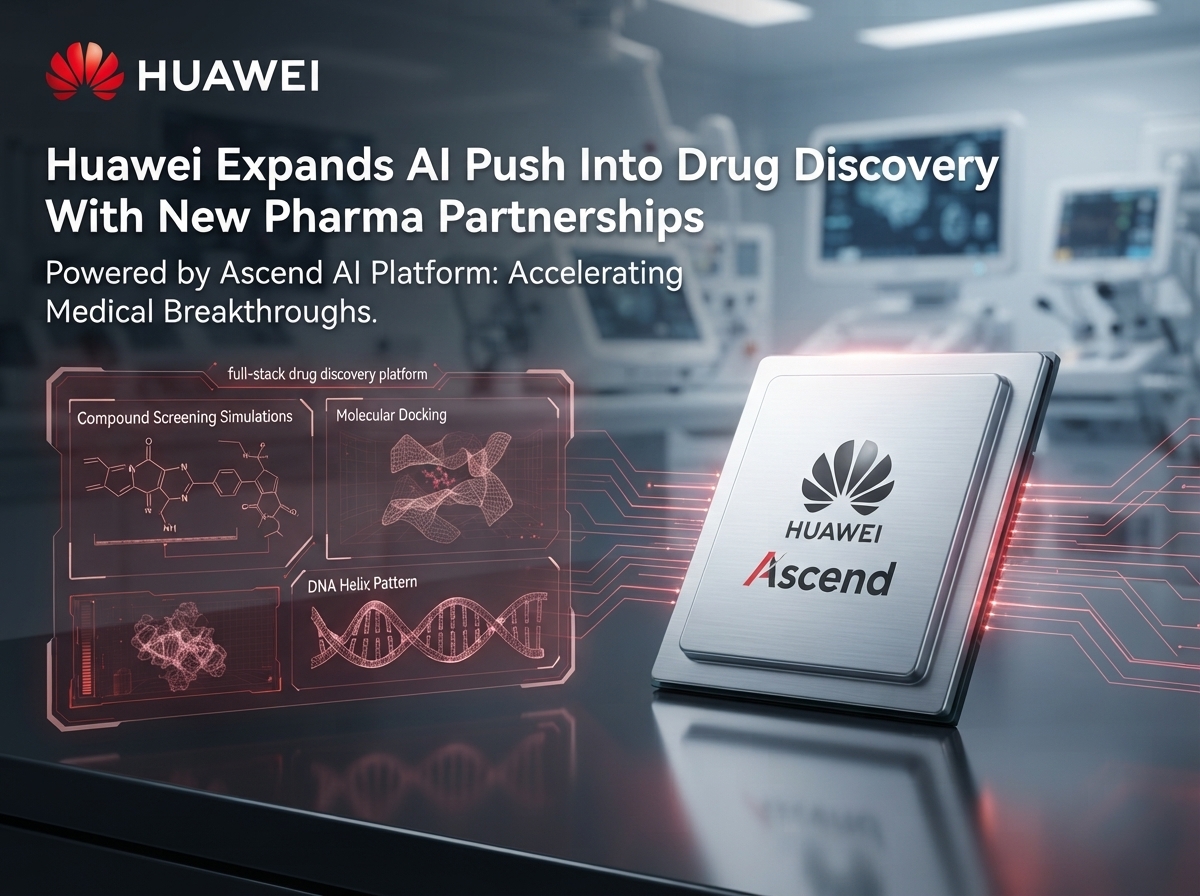
Huawei's offering goes beyond software. The company combines AI-powered compound screening tools with its Ascend AI accelerators and Kunpeng processors, giving researchers a full-stack platform for training and running drug discovery models. Earlier this year, Huawei and Guangzhou Pharmaceutical Holdings announced what they described as the industry's first production validation of AI drug research models built on Huawei's chips.
The move comes as AI rapidly transforms pharmaceutical research. Drug companies worldwide are increasingly using machine learning to identify promising compounds, design new molecules, and optimize clinical trials—potentially cutting early-stage drug development time and costs by as much as half over the next few years. Huawei is now positioning itself to capture a share of that growing market, alongside rivals like Nvidia, which has already signed major AI partnerships with companies including Eli Lilly and Novo Nordisk.
Why it matters: AI is becoming a core technology for pharmaceutical innovation, and Huawei wants to supply the computing infrastructure behind it. As competition shifts from building chatbots to powering entire industries, healthcare and drug discovery are emerging as one of AI's biggest long-term growth opportunities.