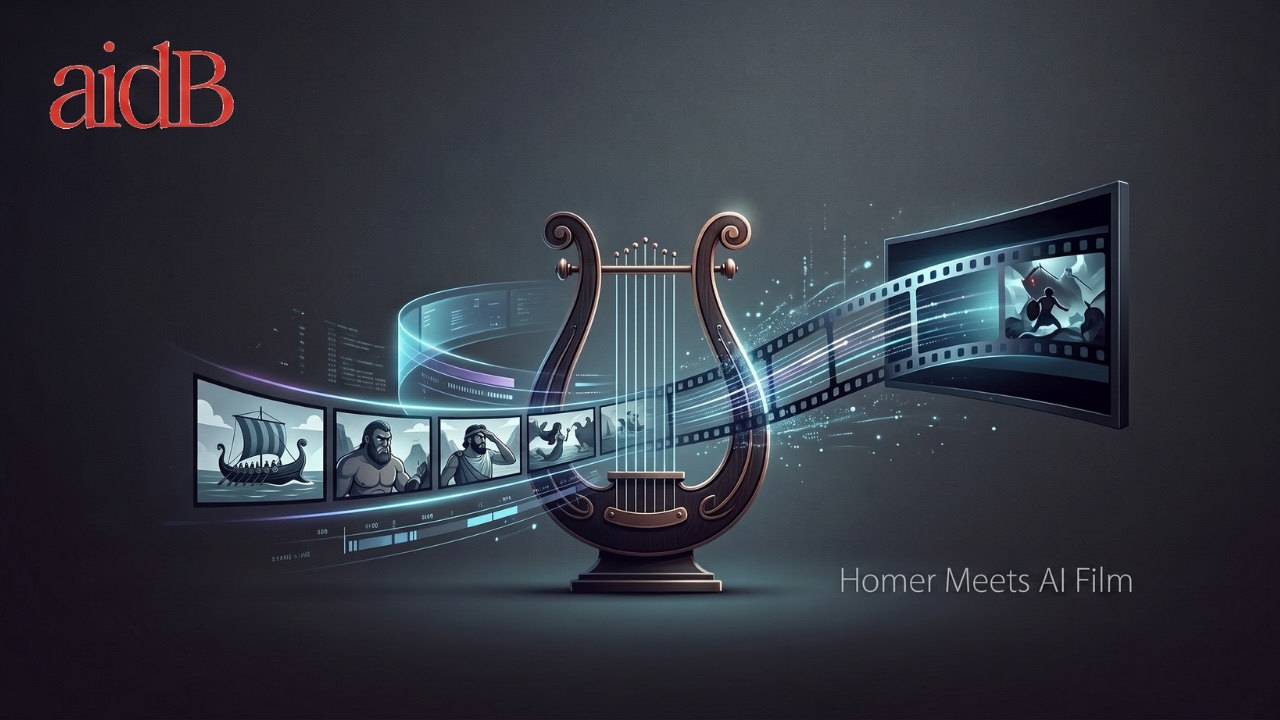
Grok Imagine just awarded $185,000 to solo creators who turned The Odyssey into short films—without studios, crews, or multi-year production schedules.
On September 4, 2026, Grok Imagine announced the winners of its Odyssey filmmaking contest, a two-week sprint challenging U.S. creators to turn scenes from Homer’s epic into 3–5 minute AI-generated films.
The premise was simple.
Use Grok’s image, video, and voice tools. Pick a moment from The Odyssey. Make it cinematic.
The results were anything but simple.
Hundreds of creators entered. Judges weighed creativity and production quality alongside U.S. Verified Home Timeline impressions, then checked that finalists had actually created their films using Grok Imagine.
The original contest tagline turned out to be remarkably accurate:
Homer had a lyre. You have Grok Imagine.
The contest opened August 17 and closed August 31.
To qualify, creators had to quote the official @grok announcement with a film that was:
Creators could still use outside tools for editing, music, and sound effects.
Community trackers eventually counted 326 entries.
The timing was also hard to miss.
Elon Musk had spent part of the summer criticizing Christopher Nolan’s upcoming Odyssey adaptation, particularly its casting, while arguing that Grok Imagine could eventually produce a version that was more “historically accurate and true to the art of Homer.”
The contest turned that claim into something more interesting than an argument on X.
It became an open studio.
If the technology was really capable of filmmaking, anyone could test it.
Hundreds did.
Grand prize winner Nem Perez (@NemPerez) took a route many adaptations overlook.
His five-minute film restores the Phaeacians—and Princess Nausicaa—to the center of the story.
In Homer’s poem, Odysseus washes ashore among the Phaeacians and tells them the story of his long journey home. Perez rebuilt that framing device, allowing Odysseus to recount what kept him moving through everything he endured: his wife, his son, and the possibility of returning home.
That emotional focus became the film’s center of gravity.
Perez described it as his longest and most intricate project yet. He used Grok for research and scripting, then Grok Imagine for characters, environments, voices, and every shot.
Later, he published a production breakdown covering research, story beats, cinematography, music, editing, and sound design.
It reads much less like someone “typing a prompt” and much more like the job description of an entire film crew compressed into one person.
The story was personal, too. Perez, a husband and new father, said Odysseus’ memories of family strongly resonated with him.
Grok’s own congratulatory post praised the film for restoring “the heart of the Odyssey with real depth and cinematic craft.”
Watch the entry: Nem Perez on X
Second place went to JSFILMZ0412, who did something even more ambitious:
He rewrote Homer.
Unsatisfied with the original ending, the creator imagined an older Odysseus sitting with the next generation after finally returning home, hoping he lives long enough to watch them grow.
The idea came from somewhere deeply personal.
The creator, a father dealing with health issues, explained that the longing to remain present for his children was the emotional core of the film.
He also praised the contest for rewarding dialogue and storytelling rather than simply spectacular visuals.
That distinction matters.
A large amount of generative video still feels like a trailer for a movie that does not exist: beautiful shots, dramatic music, very little underneath.
This entry tries to be an actual scene.
Something you are meant to stay with.
Watch the entry: JSFILMZ0412 on X
Third place winner Allen T. (@Mr_AllenT) tackled one of the most famous episodes in the poem: Odysseus confronting Polyphemus.
But instead of treating the Cyclops like a fantasy monster, Allen approached the sequence as horror.
Odysseus and his men enter the cave. The creature becomes less of a mythological prop and more of a problem of darkness, scale, movement, and dread.
Allen later shared his production workflow.
His process began by locking character sheets before generating scenes. From there, he prompted shots like a cinematographer: specifying lens choices, camera height, movement, lighting, composition, and depth of field before assembling everything into the finished sequence.
That workflow reveals something important about where AI filmmaking is heading.
The model may generate the frames.
The creator still has to direct them.
Watch the entry: Mr. Allen T. on X
Then there was @alx.
His entry, The Legend of Kekius Odysseus, reimagined the journey with a frog crew arriving on a Greek shore.
Naturally.
It became the most-viewed film in the competition based on U.S. Verified Home Timeline impressions and earned a $10,000 honorable mention.
It was ridiculous.
It was memorable.
And according to the contest rules, that mattered.
Engagement is an imperfect measure of filmmaking quality, but the competition explicitly included reach in its judging criteria. A meme that can still operate as a coherent scene represents a very different kind of creative success.
Watch the entry: alx on X
The more interesting picture emerges when you look beyond the winners.
Creators produced a 1950s noir version of The Odyssey filled with detectives, nightclubs, and gods.
Others recreated Circe’s banquet and the transformation of Odysseus’ men into swine.
There were interpretations of Calypso’s farewell, the Telemachy, the bow contest, and the slaughter inside the great hall.
Some creators treated Grok Imagine like a virtual camera department.
Others treated it like a writers’ room, casting office, sound stage, cinematography team, and visual-effects house rolled into one.
That range may be the most important part of the contest.
Not long ago, an “AI short film” usually meant a collection of attractive shots held together by music and narration, with characters changing faces between scenes and locations obeying no recognizable geography.
This contest demanded more.
Dialogue.
Continuity.
Story.
Project verification.
The winning pieces were not merely clips.
They were scenes with beginnings, middles, endings, characters, and reasons to exist.
Hollywood still has enormous advantages.
Professional actors. Physical sets. Stunt teams. Unions. Location crews. Distribution networks. Experienced production departments.
AI does not magically erase any of that.
But something else has changed.
Hollywood no longer has a monopoly on producing five minutes that look and feel surprisingly close to cinema.
Nem Perez did not need a Phaeacian beach unit.
Allen T. did not need to construct a Cyclops cave.
JSFILMZ0412 did not need actors, costumes, lighting trucks, or a second-unit director to shoot an aging king talking with children.
That does not make studios obsolete.
It changes the cost of proving an idea.
A filmmaker with a laptop, an AI model, and a strong point of view can now produce something resembling a visual proof-of-concept and place it on the same social timeline as trailers from productions costing hundreds of millions of dollars.
That is a meaningful change.
Especially for independent creators.
The strongest entries also push back against one of the laziest assumptions about generative filmmaking: that the creator simply writes a sentence and waits for the model to do everything.
Look at the workflows behind these projects and you see something closer to traditional production.
Research.
Writing.
Character design.
Shot planning.
Continuity.
Camera decisions.
Editing.
Sound.
Music.
Iteration.
The tools are automating parts of production.
They are not eliminating taste.
In some ways, they may be making taste even more important, because when almost anyone can generate a technically impressive image, the harder question becomes:
What are you actually trying to say with it?
Musk has said Grok Imagine will attempt a full-length version of The Odyssey before the end of the year.
Whether that movie arrives—and whether anyone wants to watch it for two hours—is a completely different test.
But this contest has already answered a smaller and perhaps more consequential question.
Can individual creators now produce story-driven, cinema-adjacent work that once required an entire crew?
Yes.
Hundreds of them just attempted it in two weeks.
And several produced work good enough to earn six-figure prize money.
Homer’s poem has survived for thousands of years because every generation keeps retelling it with the tools available to them.
The lyre became the stage.
The stage became film.
Now the production studio fits inside a browser.
The tools changed.
The impulse did not.
Entries remain available in the quote thread of the original @grok announcement and through community archives such as SubmytX. Creators can experiment with Grok Imagine at grok.com/imagine.