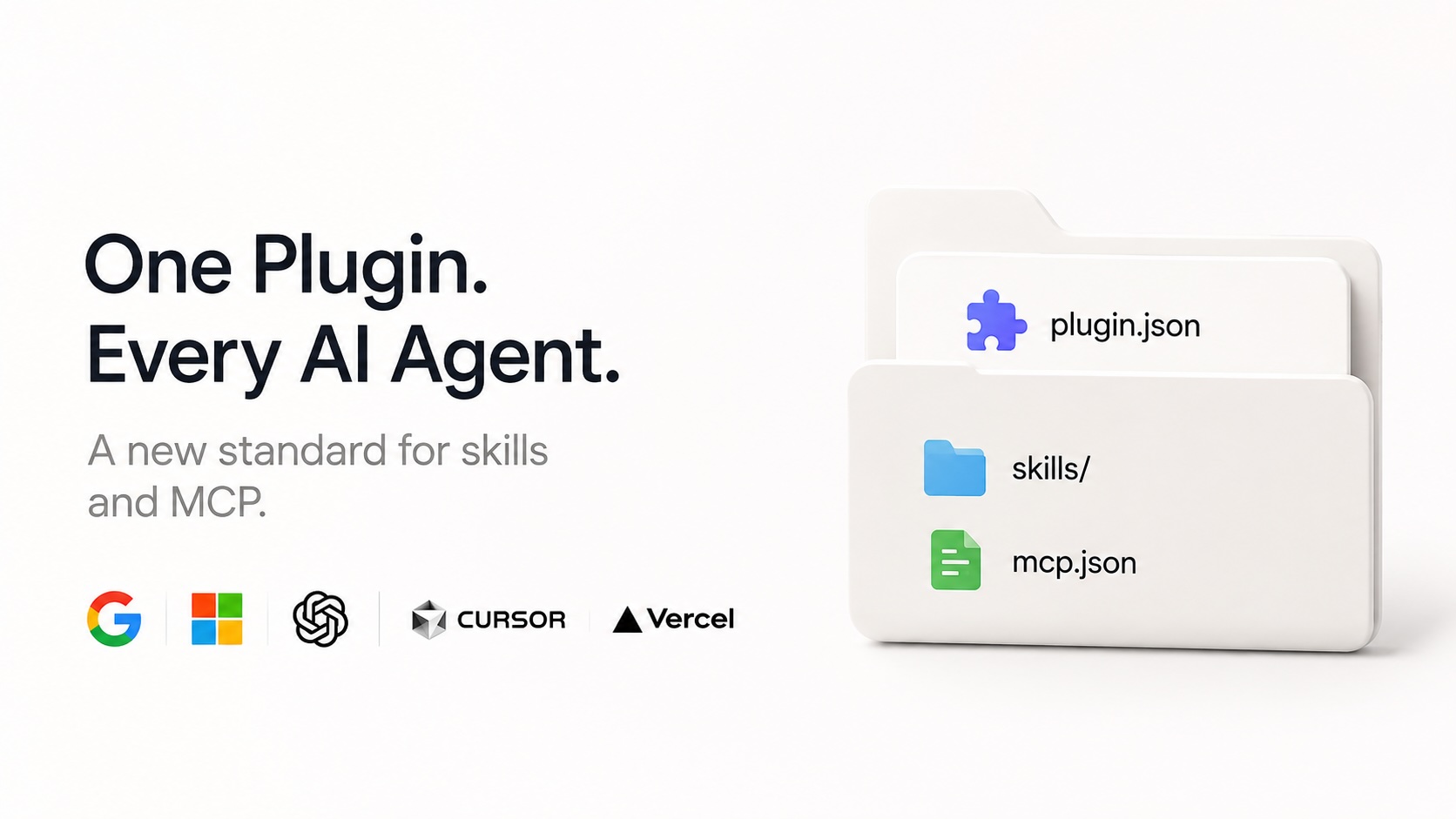
Google, Microsoft, OpenAI, Cursor, and Vercel just agreed on something pretty important:
A standard way to package MCP servers and skills for AI agents.
Write a skill once. Package it once. Multiple agents can load it.
Until now, giving a coding agent new abilities generally meant using one of two things:
Skills — folders of instructions an agent reads when needed.
MCP servers — small programs that connect an agent to tools, APIs, databases, and other services.
Both already work across different agents.
The problem was packaging.
Every platform had its own folder structure, settings files, and conventions. So the same skill might need to be rearranged for Cursor, then Copilot, then Codex.
Over time, those copies inevitably drift apart.
That’s what Agent Plugins 1.0.0 is trying to fix.
It standardizes the wrapper around these capabilities—not the capabilities themselves.
A plugin now follows a predictable structure:
📁 plugin.json — identifies the plugin
📁 skills/ — contains the skills
📄 mcp.json — defines the MCP servers
That’s basically it.
The settings file identifies the plugin rather than hiding configuration or pointing to pieces scattered elsewhere. Every compatible agent knows where to look.
If a platform needs something proprietary, it can put it in its own clearly named folder. Other agents simply ignore it.
And components fail independently. A broken MCP server shouldn't prevent the skills beside it from loading.
But there are some important things Agent Plugins does NOT standardize:
• How plugins are installed
• What permissions they get
• How publishers are verified
• How secrets and API keys should be stored
That last part matters.
A plugin can still contain code that runs on your machine. A standardized folder structure doesn't automatically make a plugin trustworthy or secure.
There’s also a notable name missing from the group: Anthropic.
Skills and MCP both originated there, and Claude Code has supported plugins with a very similar structure since 2025.
Yet Anthropic isn't part of the group steering this standard, and Claude Code isn't currently listed among the supported tools.
The initial ecosystem includes ChatGPT/Codex, Cursor, GitHub Copilot, Kiro, and VS Code.
Google also joined as a maintainer on launch day, with its Agents CLI among the first Google products shipping in the format.
This might sound like a small packaging change.
But if adoption sticks, it could mean something much bigger:
Developers build an agent capability once—and bring it almost anywhere.
I also wrote a full walkthrough using Google’s Agents CLI that shows what this looks like in practice: installing Google's agent-building skills across Claude Code, Cursor, Codex, and Antigravity, building a citation-grounded RAG agent, running a 20-scenario evaluation suite, catching a hallucination, tracing it to a single system-instruction line, fixing it, and deploying the corrected agent.