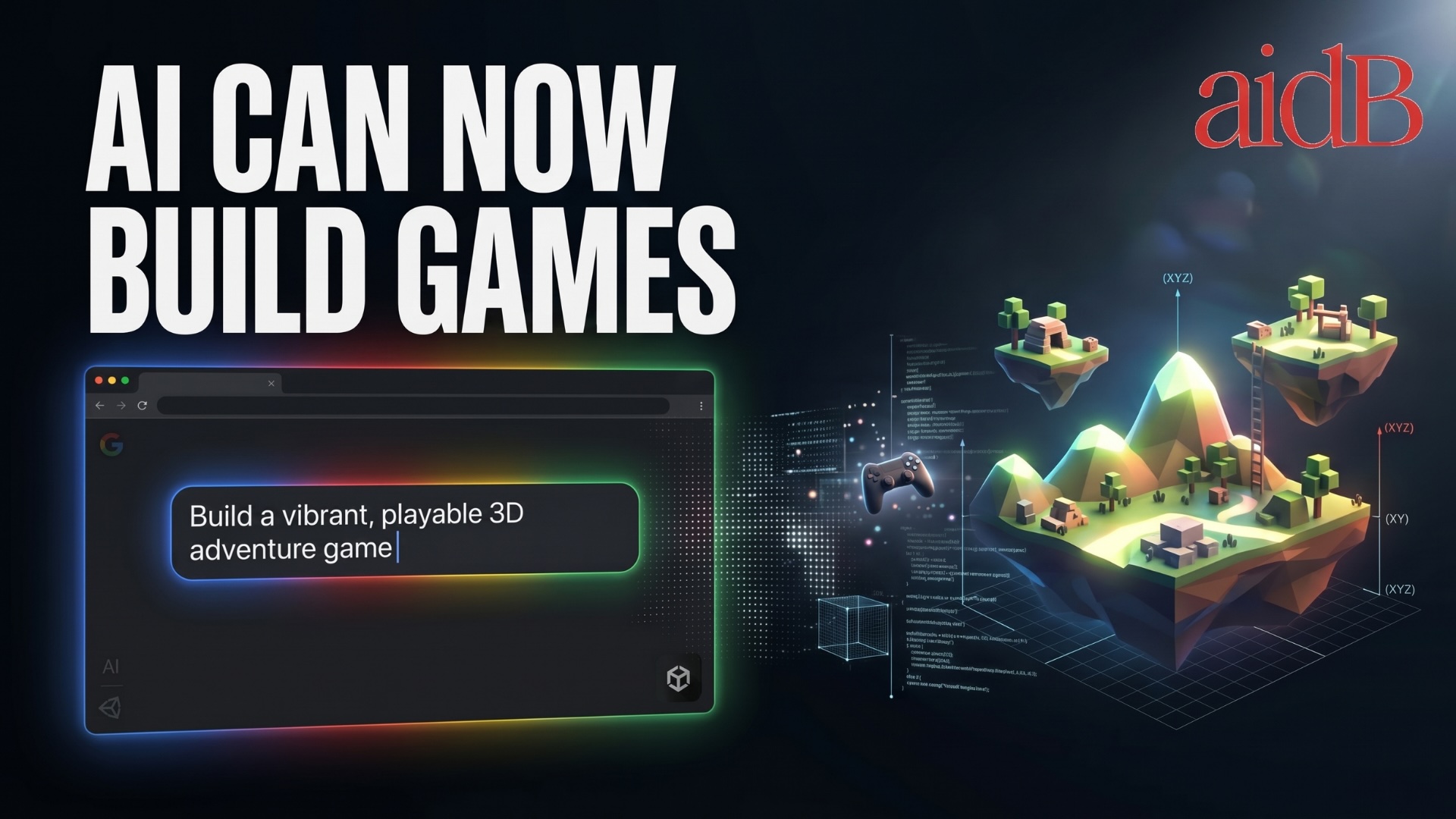
Google and Unity are teaming up to make creating a game feel increasingly like describing an idea to an AI.
On October 7, 2026, the two companies announced a strategic partnership centered on a new generation of AI-powered game creation tools. The first product, Google's experimental Playground, is available now in the United States, while a more advanced Unity-powered creation environment called Unity Spark is expected later this year.
The ambition is significant: allow people who have never written code or used a professional game engine to create, modify, play and share interactive games through natural-language prompts.
Google describes the partnership as combining its AI research and massive consumer reach with Unity's game engine, runtime and creator ecosystem.
Playground is a browser-based experimental gaming platform from Google.
Instead of starting with code, users can simply describe what they want to make.
A creator could ask for a 3D racing game, a multiplayer arena, different physics, new characters or modified rules and continue refining the experience conversationally. Google says Playground allows creators to start from scratch, remix prompts and immediately test what they create.
The platform also supports sharing and discovery. Games can remain private, be shared through a direct link or be published publicly.
Public single-player games can use global leaderboards, while Playground also supports real-time and turn-based multiplayer in an early preview. Google Play Games profiles are used for creator identities, rankings, following creators and related social features.
Perhaps one of the most interesting features is portability.
Google allows creators to download a complete copy of games created in Playground, including their HTML, JavaScript, CSS and generated assets as a ZIP file. That makes Playground more than simply a closed AI-game experiment: creators can take the underlying web game files with them.
Playground is available to U.S. users aged 18 and over. Playing existing games is free. Creation uses a token system that refreshes weekly, with higher limits available through Google One AI plans.
There is one launch-day caveat: free-tier game creation is being rolled out gradually, with a waitlist, while eligible Google One AI subscribers can receive immediate creation access.
Google Playground may be aimed initially at rapid creation, but Unity Spark is designed to take the concept further.
Unity describes Spark as a browser-based AI game maker with a real editor and the ability to create games using Unity technology without requiring previous Unity or game-development experience.
Its pitch is summarized simply:
“Prompt it. Perfect it. Publish it.”
Spark is designed to provide higher-fidelity 3D graphics, more sophisticated gameplay mechanics and the flexibility of the Unity runtime. It will integrate with Google's Playground ecosystem, allowing Spark-created games to reach Playground players.
Unity is also taking a different approach to AI-generated art.
Spark connects directly to the Unity Asset Store, meaning creators will be able to use professional assets made by artists rather than relying exclusively on AI-generated imagery.
Unity CEO Matt Bromberg says the idea is not to have AI produce cheap copies of existing games in one prompt. Instead, Unity wants people to start quickly and then continue editing, refining and building genuinely original interactive experiences.
Spark is currently in testing, with a closed beta planned.
Google and Unity are not entering an empty market.
Roblox has been aggressively expanding generative game creation through its Cube foundation model and new Build tools. Roblox has demonstrated AI-generated functional 3D objects and is working toward AI systems capable of producing complete editable and playable scenes from natural-language prompts.
Meta is pursuing a similar direction with Horizon Worlds. Its desktop editor already includes generative AI tools for creating meshes, textures, audio and code while Meta continues expanding Horizon beyond VR toward mobile experiences.
The result is an emerging race to become the platform where the next generation does not necessarily learn game development before making games.
They describe what they want.
AI handles more of the technical work.
And the creator becomes increasingly responsible for the idea, direction, taste, gameplay and community rather than every line of code.
The most important part of today's announcement may not be Playground itself.
It is the bridge being created between AI-first creation and a professional game engine.
Unity already powers games across mobile, PC, consoles, web, AR and VR. Google brings Gemini and its wider AI ecosystem alongside enormous consumer distribution.
Together, the companies are attempting to build a ladder where someone can move from:
Idea → Prompt → Prototype → Playable Game → Community → More Advanced Game Development
without encountering the traditional technical barriers at the beginning.
Unity CEO Matt Bromberg has described the broader idea as a world where interactive creation becomes something ordinary people do, rather than something restricted to professional developers.
That could prove to be one of the bigger consequences of generative AI.
AI has already lowered the barrier to writing, image creation, music and video.
Games may be next.
And if Google, Unity, Roblox and Meta succeed, the next creator economy may not consist only of people posting videos.
Millions of them could be building playable worlds.