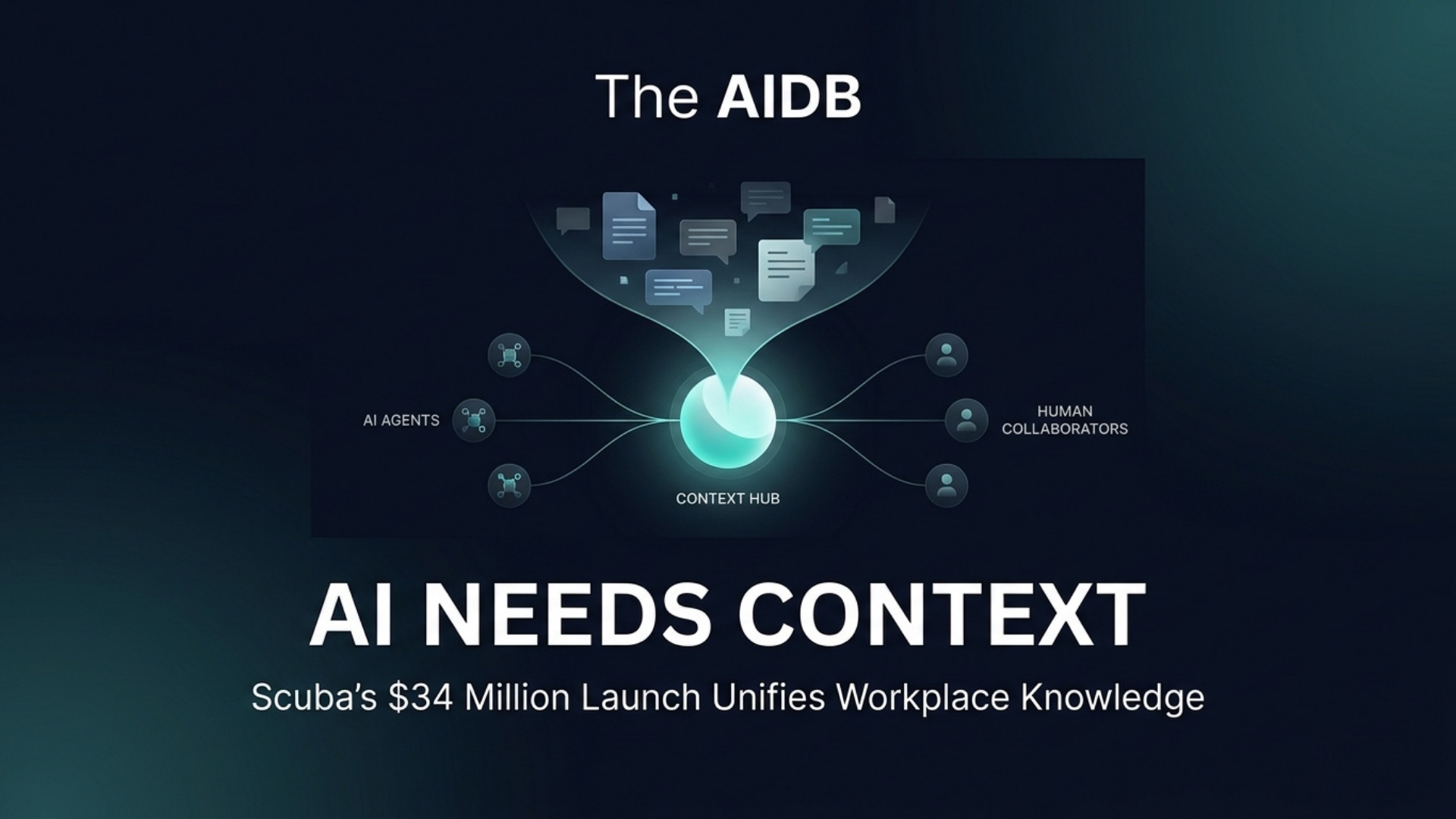
Founded by former Slack executives Noah Desai Weiss and Dolapo Falola, Scuba aims to solve a growing enterprise AI challenge: helping employees and AI agents access the same organizational knowledge, decisions, and context.
New York-based AI startup Scuba has emerged from stealth with $34 million in funding, introducing a platform designed to give human teams and AI agents a shared understanding of organizational knowledge.
Announced on October 13, 2026, the funding spans two rounds. Accel led the pre-seed investment, while Accel and IVP co-led the seed round. Other participating investors include BoxGroup, Conviction, Homebrew, and Scribble Ventures.
Scuba was founded by Noah Desai Weiss, formerly Chief Product Officer at Slack, and Dolapo Falola, who previously held engineering leadership positions at Slack, Meta, and The Browser Company.
The company is betting that one of the biggest obstacles to productive enterprise AI adoption is no longer simply the intelligence of the models, but the lack of shared context connecting AI systems with the people and teams using them.
Generative AI has made it easier for individual employees to research, write, analyze data, and develop software.
But greater individual productivity does not automatically translate into more effective teamwork.
Organizations store information across messaging platforms, shared documents, meetings, internal wikis, customer conversations, and employees' personal notes. Important decisions and the reasoning behind them can become fragmented or difficult to retrieve.
When employees use AI assistants, they frequently have to reconstruct this context manually.
They may need to explain a project's history, supply relevant documents, identify previous decisions, and describe company preferences before an AI system can produce an appropriate response.
The challenge becomes more complicated as organizations introduce autonomous AI agents capable of carrying out tasks across multiple tools.
These agents may have access to substantial technical capabilities without understanding the company's priorities, institutional knowledge, or established ways of working.
Scuba's founders believe this gap creates an opportunity for a new category of enterprise software: a persistent, shared context layer that can serve employees and AI agents alike.
Scuba describes its platform as a shared context engine.
Rather than replacing existing workplace applications, the product is intended to collect, organize, and make relevant information accessible across the tools employees already use.
Its initial offering centers on several capabilities.
Captures: Saving organizational knowledge
Users can save articles, documents, screenshots, videos, conversations, and other information directly into Scuba.
The platform processes this material, generating summaries and highlighting information that may be useful later.
The objective is to make knowledge capture easier, rather than requiring employees to maintain extensive documentation manually.
Collections: Organizing shared context
Scuba organizes saved information into Collections.
A Collection might contain material relating to a product launch, customer account, competitive analysis, or strategic initiative.
These shared spaces allow employees to access relevant knowledge gathered by colleagues and build upon previous work.
Briefings: Identifying what has changed
The platform can generate briefings highlighting emerging trends, important developments, and potentially conflicting information across a team's saved material.
This could help employees identify changes that might otherwise remain buried in separate documents or conversations.
AI integrations: Bringing context into existing assistants
One of Scuba's central features is its integration with AI tools through the Model Context Protocol (MCP).
The platform is designed to work with tools including ChatGPT, Claude, Cursor, and Slack, allowing supported AI workflows to access relevant saved context.
This approach aims to reduce the need for employees to repeatedly supply the same background information when working with different AI assistants.
Scuba's funding reflects investor interest in software designed to support a workplace increasingly populated by AI agents.
Its backers include established venture capital firms and technology entrepreneurs associated with Slack, Stripe, LinkedIn, Instagram, Dropbox, Salesforce, and other technology companies.
The founders' experience is also relevant.
At Slack, Weiss and Falola worked on products built around workplace communication, information discovery, and collaboration.
Scuba extends that problem into a new environment where teams must coordinate not only with colleagues but also with AI systems capable of independently generating and executing work.
The company says hundreds of early users have tested Scuba during a six-month private beta, using it for product development, launches, strategy, and market research.
The newly announced funding will support further product development, hiring, and commercial expansion.
Scuba is currently opening access to additional teams in waves, rather than offering unrestricted general availability.
National Law Review
+1
Scuba's launch points to a wider question about the future of enterprise AI: What makes an intelligent assistant genuinely useful inside a specific organization?
Advanced models are trained on extensive amounts of information, but that does not mean they understand the internal decisions, relationships, preferences, and history that shape a particular business.
Two competing companies may have access to similar AI models, yet produce different results because one has better-organized internal knowledge.
For example, an AI agent asked to prepare a product launch strategy might need more than market information.
It may also need to understand why the company rejected a previous launch approach, which customer segments matter most, what executives have already approved, and how the company's positioning has evolved.
Without that context, an otherwise capable model may generate a technically reasonable recommendation that conflicts with existing decisions.
Scuba is attempting to make this accumulated organizational knowledge more accessible and reusable.
If successful, products in this category could help companies move from isolated AI productivity gains toward more coordinated AI-assisted operations.
But the opportunity is not without competition.
Workplace software providers already offer enterprise search, knowledge management, collaboration, and AI-assisted information retrieval. Companies such as Microsoft, Google, Atlassian, Salesforce, and Notion have strong incentives to make organizational information more accessible to AI systems.
Scuba will therefore need to demonstrate that a dedicated shared-context layer provides meaningful advantages over capabilities integrated directly into existing enterprise platforms.
Although Scuba's approach addresses a recognizable enterprise problem, several questions remain.
The first is information quality.
Saving and organizing large quantities of material does not guarantee that the resulting knowledge is accurate, relevant, or current. Organizational memory can contain contradictory decisions, outdated assumptions, and incomplete records.
The second challenge is access control and privacy.
A shared context system may hold commercially sensitive discussions, customer information, and internal strategic decisions.
Organizations will need confidence that AI agents receive only information they are authorized to access, especially when different teams or external collaborators have varying permissions.
The third challenge is measurable value.
Scuba will need to show that its technology improves team performance, reduces duplicated work, or produces more useful AI outputs, rather than merely creating another place to store information.
The company's early adoption and funding provide evidence of interest, but they do not yet establish broad enterprise effectiveness.
Scuba's launch reflects a potentially important shift in how businesses evaluate AI systems.
The industry has spent years emphasizing model capabilities, benchmark performance, and increasingly sophisticated agents.
But organizations also need those systems to operate within real business environments, where priorities change, decisions accumulate, and institutional knowledge matters.
The competitive advantage may increasingly depend on how effectively companies connect capable AI models with reliable, current, and appropriately permissioned organizational information.
Scuba is positioning itself at that intersection.
Whether it becomes an important independent enterprise platform or helps accelerate similar features across established workplace software, the underlying problem is unlikely to disappear.
As AI agents take on more work, the ability to give them the right organizational context may become just as important as the intelligence of the models themselves.
For more information, visit Scuba's official website.